

The ethnonym “Albanians” has its roots in the name of an ancient tribe known as the Albanoi, who were first mentioned around the 6th century BC. The Albanoi were also mentioned by Ptolemy, the Greek geographer and astronomer, in the 2nd century AD.
According to Ptolemy, the Albanoi inhabited an area in the central part of present-day Albania. Their capital was known as Albanopolis.
Albanopolis: The White City
The name “Albanopolis” combines the Latin word “albus,” meaning “white,” with the Greek word “polis,” meaning “city,” thus translating to “White City.”
Interestingly, the term “White City” is a common toponym in Slavic languages, usually referring to a capital city or an important city of a particular region. For example, Belgrade means “White City” in Serbian, and Belogradchik carries the same meaning in Bulgarian. The same is true for Belgorod in Russia and Bilhorod-Dnistrovskyi in Ukraine, to name a few. Additionally, both Kiev and Moscow were known as “white cities” at some point.
This suggests that the toponym “Albanopolis” may be a translation of a term from a Slavic linguistic tradition, rather than Albanian. Similarly, in modern times, the name Kosovo derives from the Serbian word “kos,” meaning “blackbird,” combined with the possessive suffix “-ovo,” resulting in “Field of Blackbirds.” This name holds no particular meaning in the Albanian language.
Berat, Albania was once known as Belgrade
One of the largest cities in Albania, Berat, was known as Belgrade in the Middle Ages, and the modern Albanian name is just a corruption of that Slavic name. This word by itself doesn’t have a meaning in Albanian.
Now, the location of the ancient Albanopolis has never been discovered. Not much scholarly work was even done in that regard. Some scholars suggested that the ancient name of Berat was Antipatreia, but if you look closely at the maps below, you will see that their locations are matching pretty closely!
As the true location of Albanopolis is unknown, and Berat lies only around 100 km from where Ptolemy placed it, I believe that it was precisly Berat that was once known as Albanopolis!

The Albanoi Tribe of the Caucasus
Caucasian Albania was an ancient kingdom situated in the Caucasus region, largely corresponding to modern-day Azerbaijan. The people of this region were known as the Albanoi, similar in name to the ancient tribe mentioned by Ptolemy in the Balkans.
This similarity in names has led some to speculate that there might be a direct link between the two groups. However, this tribe clearly had nothing to do with the Albanians, whose genetics show no Caucasian influence but instead reveal a strong influx of North African genetics.
The dominant haplogroup among Albanians, specifically haplogroup E1b1b, has strong connections to North Africa rather than the Caucasus. This haplogroup is prevalent in North African populations. The genetic makeup of modern Albanians is thus markedly different from that of the ancient Caucasian Albanians.
The Serboi Tribe of the Caucasus
The Serboi (also known as Sirbi) were another ancient tribe mentioned by Ptolemy in his “Geographia.” According to Ptolemy, the Serboi inhabited a region near the Caucasus, specifically in the area around the Caspian Sea.
Some historians have posited that the Serboi might have a connection to the Serbs or at least to the Slavic peoples. This theory is based on the similarity in names and historical migration patterns. In this case, genetics paint a different picture, as there are many common characteristics between Slavs and Serbs and the Caucasus.

Linguistic Evidence
The Albanian language is replete with Slavic borrowings, a peculiar phenomenon if Albanian were the original language of the Balkans. This linguistic influence is so profound that many fundamental terms related to agriculture and daily life in Albanian are of Slavic origin.
Conversely, there are virtually no Albanian borrowings in the Serbian language, underscoring the asymmetry of linguistic exchange. Such a linguistic landscape challenges the notion of Albanian primacy in the region, suggesting a significant Slavic influence on the evolution of the Albanian language. More info here.
The Albanopolis Inscription
There is only one ancient inscription that mentions Albanopolis. It is a tombstone from Gorno Sonje, Sopiste, North Macedonia, dated to 1-2 century BC.
The official translation of the inscription is a bit confusing and dated in my opinion. Officialy, it reads:
POSIS MESTYLU F[ILIUS] FL[AVIA] DELVS MVCATI F[ILIA] DOM[O] ALBANOP[OLI] IPSA DELVS”.
This is translated as “Posis Mestylu, son of Flavia, daughter of Delus Mucati, who comes from Albanopolis”. “
However, this translation could only make sense if the alleged “Posis Mestylu” was a transgeder person – a son and a daughter at the same time.
My reading is here:
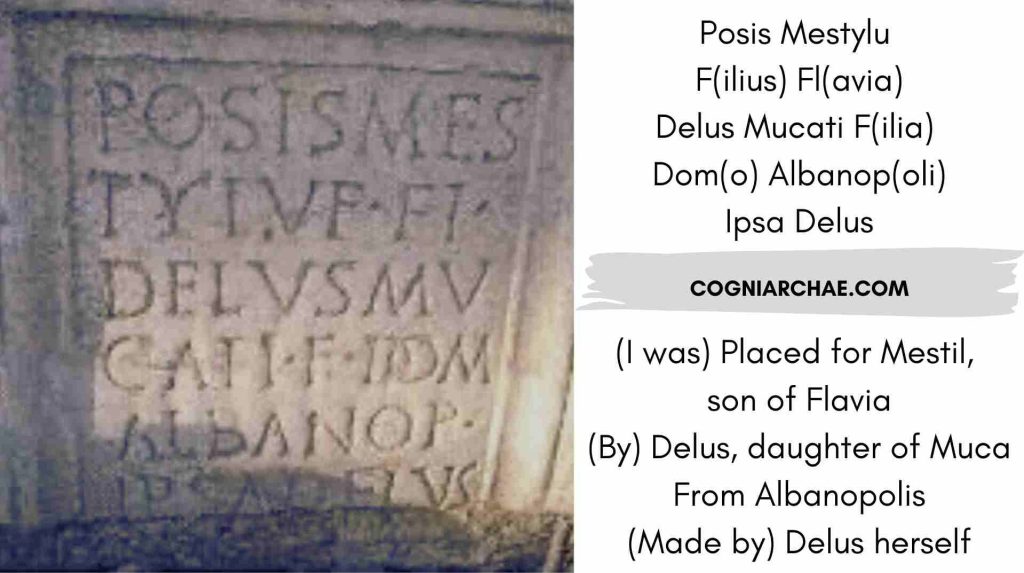
This inscription is important, not only because it mentiones Albanopolis, but also because it gives us the names of its inhabitants: Mestil, Flavia, Delus and Muca.
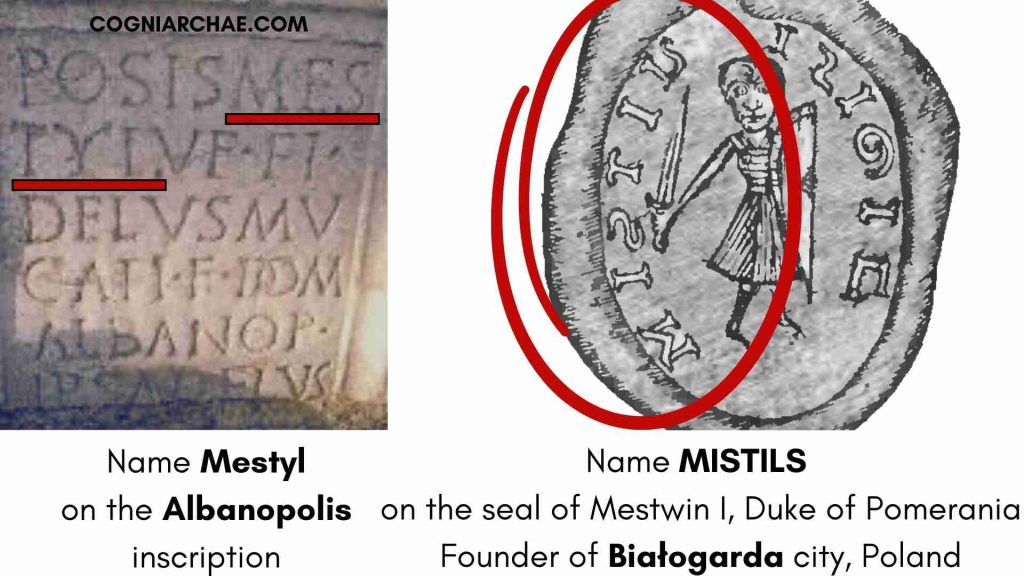
And while Flavia and Delus sound romanised, the names Mestil and Muca are much more interesting because they can only be interpreted through Slavic languages.
The name similar to Mestil – Mistils, appears on the medieval seal of Mestwin I, Duke of Pomerania. Funny enough, he was also the fonder of Białogarda in Poland, which just like Albanopolis, translates to “the white city”!
As for the name Muca (Muka), it is well-attested in both Albanian and Slavic lands. However, while the Albanian etymology is obscure, the Slavic one is very clear. It stems from the word muka, meaning “flour”, and it was a popular medieval name for families who were producing it. Read more here.
Final Thoughts
Here is a quick summary of pure historical facts:
⁃ The ethnonym “Albanians” is derived from an ancient tribe of Albanoi, whose capital was known as the “White City.”
-The true location of Albanopolis is not known but the medieval name of Berat, Albania, was Belgrade, meaning “white city” in Slavic languages. Berat is located near the place where Ptolemy places Albanopolis.
⁃ Serbian and Slavic capitals in general are usually known as “white cities.”
-The only known ancient inscription that mentions Albanopolis also mentiones two personal names that have clear Slavic roots.
-The Alabanian language is full of Slavic borrowings, but there are no Albanian borrowings in the Slavic languages.
⁃ The Albanoi were first mentioned by Ptolemy in the second century AD, along with another tribe with the same name, living in the Caucasus. In the Balkans, the neighbors of the Albanians are Serbs, just like in the ancient Caucasus, the neighbors of the Albanoi were the Serboi.
So here is the big question: Were modern Albanians the original inhabitants of Albania, or did they simply adopt the name of another Slavic tribe, possibly during the Ottoman occupation of the Balkans, and in a fashion very similar to how some modern Albanians identify with Serbian territory of Kosovo?


The “white city”, “white castle/palace” or “white house” is quite a common naming convention in a lot of languages, there are also districts and counties called “white” in a lot of non slavic territories.
Even the now slavic Bilhorod-Dnistrovskyi is a translation, the casle was built by byzantines (greeks) and called it Asprokastron “white castle” before it became Bilhorod.
But they also built a castle for the khazars and that was called Sarkel “white fort/city”…
But we can go further, and we can find Aksaray “white palace” in central Anatolia, Castelo Branco “white castle” in Portugal, or try to find Kahã Kamasa / Ciudad Blanca “white city” in Honduras… Even the power center of the USA is White House, but not because of slavic traditions…
Good point! There are many other similar toponyms, although not that many whose name can translate to “white city”. In Slavic lands, toponyms like “white church”, “white castle”, “white lake”, “white river”, “white hill” would be impossible to list in one article.
However, the focus of this article was not only on the correlation Alabanopolis – Belgrade, but also on. The Serbs – Albanians of the Balkans & Serboi and Albanoi of the Caucasus, as well as the corresponding linguistic and genetic evidence. In short, there is a bit more to it than just two matching toponyms.