

A Landmark Study
In 2025, Nature published Ancient DNA connects large-scale migration with the spread of Slavs, presenting the largest dataset to date: 555 ancient genomes, including 359 from early Slavic contexts. The study argued that between the 6th and 8th centuries CE, over 80% of the local gene pool in Poland, Eastern Germany, and Croatia was replaced by migrants carrying a “Slavic” genetic profile rooted in Belarus and Ukraine.
The authors interpreted this as proof that the historical expansion of Slavs was driven by massive migration, vindicating the migrationist view over the Polish “autochthonist” continuity school.
The Cracks in the Narrative
1. Cremation bias:
Early Slavs predominantly cremated their dead. The few inhumations sampled genetically may represent atypical groups, not the mainstream population.
2. Chronology mismatch:
The “Slavic” genetic signature dates to ~1000 BCE, a millennium before Slavs appear in Byzantine texts. This suggests a much older origin than the paper allows.
3. Genes ≠ language:
The study risks equating a genetic profile with a linguistic identity. But Slavic speech is first attested only in the 6th century CE, and language shifts can occur without large-scale replacement.
4. Regional variation overlooked:
Replacement was strongest in Poland and East Germany, but in the Balkans and Volga regions, admixture and continuity were the rule. A single “mass migration” narrative flattens this diversity.
5. The Historical Blind Spot:
Finally, in multidisciplinary studies of this kind, genetic research is usually paired with archaeological and historical evidence. Yet in this case, all the primary Slavic sources are conspicuously absent. Medieval Slavic chronicles — from the Russian Primary Chronicle to the Croatian Chronicle of the Priest of Duklja — unanimously record that the Slavs expanded northward from the Balkans. On this point there is no disagreement, even if these accounts were written centuries after the supposed 6th–8th century migration.
Ignoring these testimonies, while anchoring the homeland in the forests of Belarus where archaeological correlates are scarce, creates a major gap in the argument.
The 1000 BCE Horizon: Lusatia and Žuto Brdo, not the forests of Belarus
The study found that around 1000 BCE there was a fusion of Baltic–steppe-related groups (R1a/I2 lineages, WHG + steppe ancestry) with Carpathian–Balkan farmer-descended groups (EEF ancestry), creating the genetic profile later characteristic of Slavs.
However, the Nature study makes a weak case for an unattested admixture in the forests of Belarus, where archaeological correlates are scarce and early farming populations would have had little incentive to settle.
I would like to propose a different theory.
The admixture clock (~1000 BCE) coincides with a flourishing frontier between two cultures:
• Lusatian culture (Poland, 1300–500 BCE): fortified settlements (e.g., Biskupin), urnfield cremations, and a role in the wider Urnfield koine of Europe.
• Žuto Brdo–Gârla Mare complex (Serbia–Romania, 1300–900 BCE):urnfields, bronze workshops, and Balkan–Carpathian exchange networks.
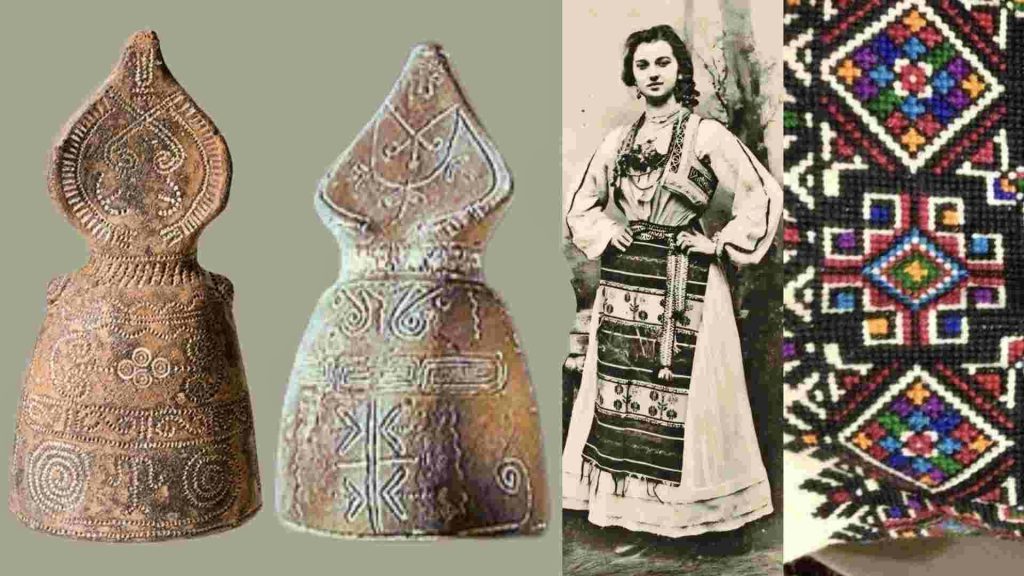
Archaeologists have long noted parallels between the two: shared burial practices, metalwork, and cross-Carpathian trade. This Lusatia–Žuto Brdo horizon fits perfectly as the locus where Baltic/steppe ancestry (R1a/I2) mixed with farmer-descended Carpathian/Balkan groups (EEF ancestry).
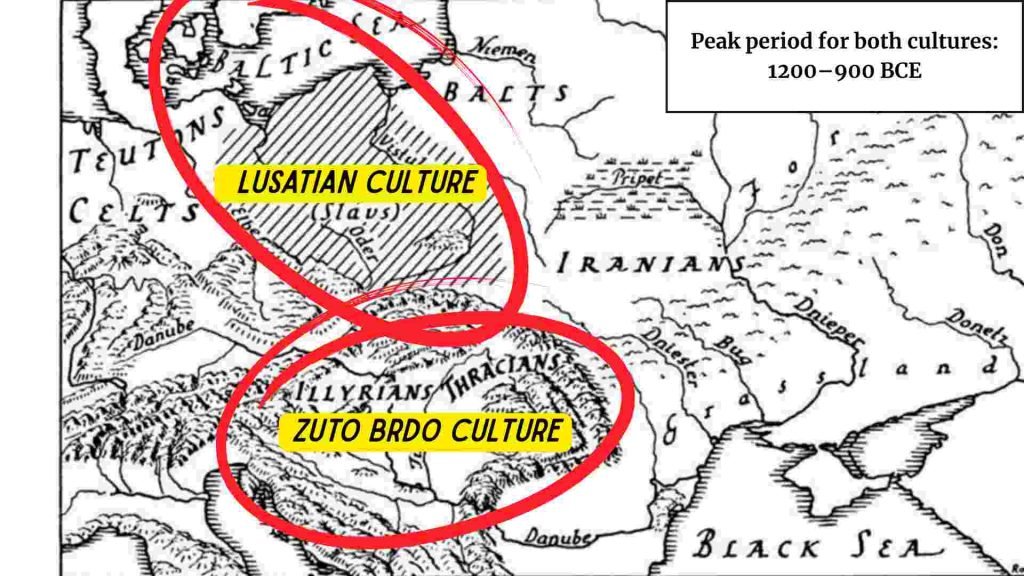
This makes it a strong candidate for the true origin of the Slavic genetic profile.
Forces of Movement: Why Did Populations Shift?
• Late Bronze disruptions (c. 1200 BCE): The collapse of the Mycenaean world, Hittite empire, and instability across Europe triggered Urnfield migrations, which could have pulled Lusatian-linked groups both north and south.
• Hallstatt and early Iron Age (800–500 BCE): Rising Celtic groups in Central Europe may have pressured Lusatian-descended populations into the Carpathian zone.
• Roman frontier (1st–4th c. CE): The Danube frontier drew Balkan groups southward, while pressure from Germanic tribes (Goths, Vandals) displaced communities northward. Slavic speech, if already lingua franca in the Carpathian–Danube–Polish plain, could have persisted beneath these shifting political overlays.
• Avar Khaganate (6th–8th c. CE): Avars dominated the Carpathian Basin, forcing local groups into new alliances. When Avar power collapsed (late 8th c.), Slavic-speaking communities re-emerged across the Balkans and Central Europe, giving the illusion of a “migration wave.”
Slavic as Lingua Franca
If the Lusatia–Žuto Brdo horizon created the Slavic substrate around 1000 BCE, then Slavic speech may have circulated across this frontier for centuries. By the time Byzantines first recorded the Sklavenoi in the 6th century CE, the language was already a deeply entrenched lingua franca, not a newcomer.
This explains the sudden, wide appearance of Slavic languages in historical sources: it was not the invention of a new tongue, but the resurgence of one long established in the Carpathian–Danube corridor.
Conclusion: The Re-Emergence, Not Migration
The Nature study is a milestone, but its interpretation — Slavs as migrants arriving from Belarus/Ukraine in the 6th–8th centuries CE — may be too narrow.
• The genetic profile dates back to ~1000 BCE, where the Lusatia–Žuto Brdo horizon better explains its formation.
• Slavs were not “born” in the 6th century; they were long-standing frontier populations, whose movements were shaped by Bronze Age disruptions, Celtic expansion, Roman frontiers, and Avar rule.
• The 6th–8th century “Slavic migration” is better seen as a re-expansion within an ancient homeland, not the arrival of a new people.
In this light, Slavic ethnogenesis is not a story of sudden migration, but of deep continuity on a shifting frontier — a memory of movement stretching back a thousand years before the chronicles begin.
Therefore, the Nature study has not captured the birth of the Slavs at all, but rather their re-emergence — a return to the very ancestral lands where their genetic and cultural roots had been laid a thousand years before.


