

Excerpt:
When the Sun once rose in Ophiuchus at harvest time, the word artem meant wheat. As the heavens shifted with precession, the same name came to mean truth, cosmic order, and sovereignty.
The goddess who carried it — Artimpasa, later remembered as Artemis — preserves the memory of the world’s first farmers.
A Hero and the Serpent-Bodied Goddess
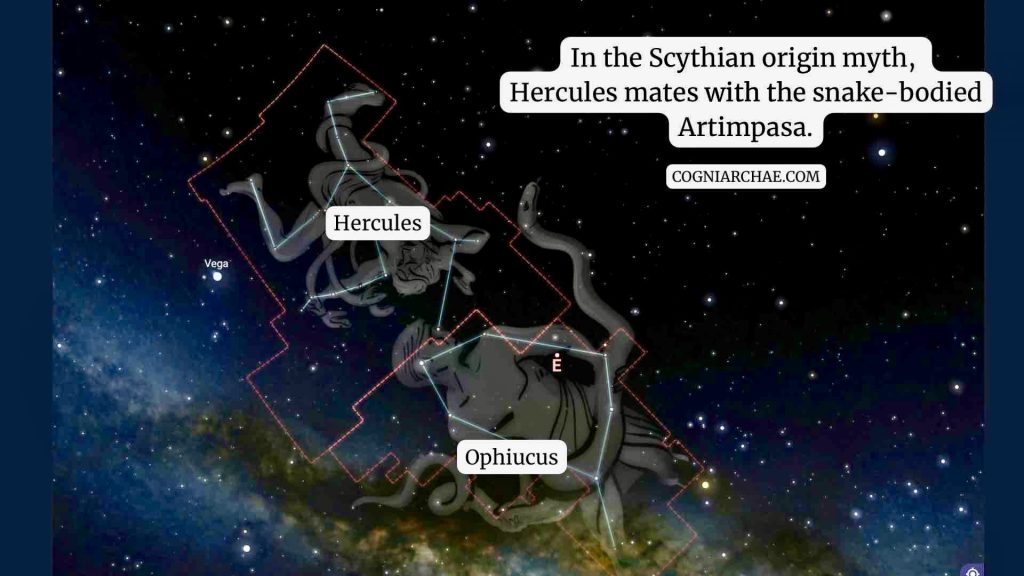
Herodotus recounts that the Scythians claimed descent from a wondrous union: Heracles, weary from his labors, wandered into Scythia and lay with a goddess who was half-woman, half-serpent.
He found her in a cave dwelling, her lower body coiled like a snake, her upper body radiant with the form of a queen. She detained him, returned his horses only after lying with him, and from their union came the first kings of the Scythians.
Later Scythian art shows this same goddess enthroned, arms extended, flanked by beasts, sometimes holding the implements of sovereignty — a mirror, a rhyton, or a sword.
From Altamira to Artimpasa
This unusual Scythian image, however, is far older than the Scythians themselves. The half-woman, half-serpent motif — now most familiar from the twin-tailed siren on the Starbucks logo — can be traced back tens of millennia. In the cave art of Altamira, painted some 36,000 years ago by Cro-Magnon hunters, a figure with human and serpentine traits already appears.
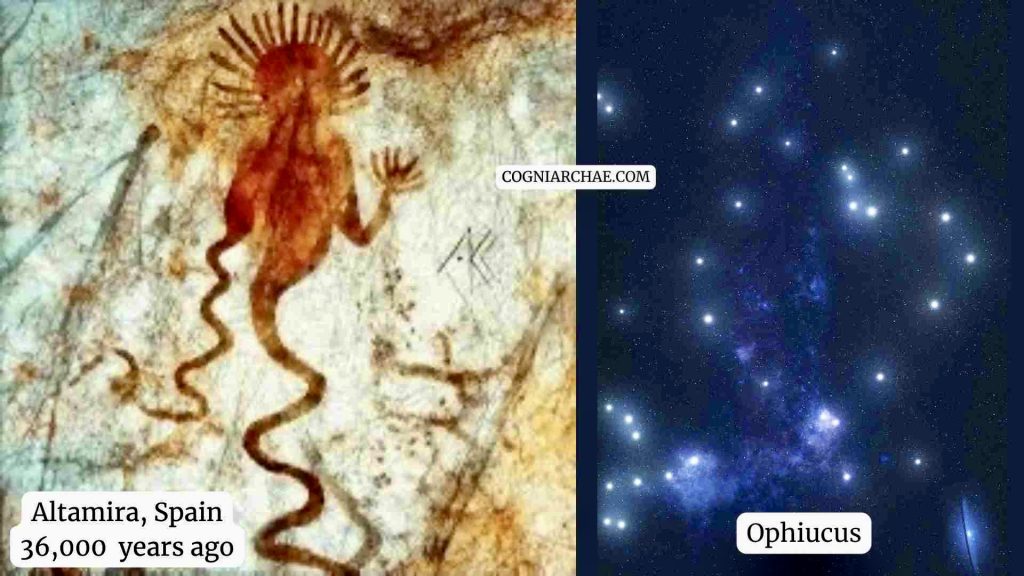
And perhaps we glimpse it again in the 8,000-year-old cave paintings at Pla de Petracos in Spain, where schematic human forms fuse with serpentine and vegetal motifs. Moreover, one more figure is depicted above it, where we would expect to see the constellation Hercules.
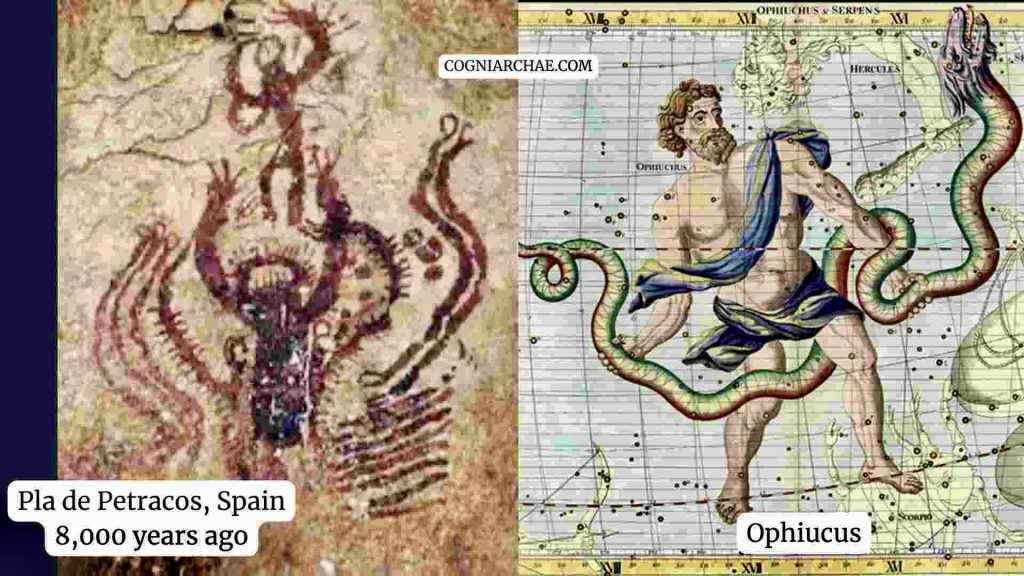
Isn’t it striking that the cave images of serpent-bodied women mirror Herodotus’ tale of Heracles meeting Artimpasa in a cave?
What these paintings meant to their makers is impossible to say with certainty, but when such images echo across ages and cultures, it is usually because they reflect something permanent in the sky.
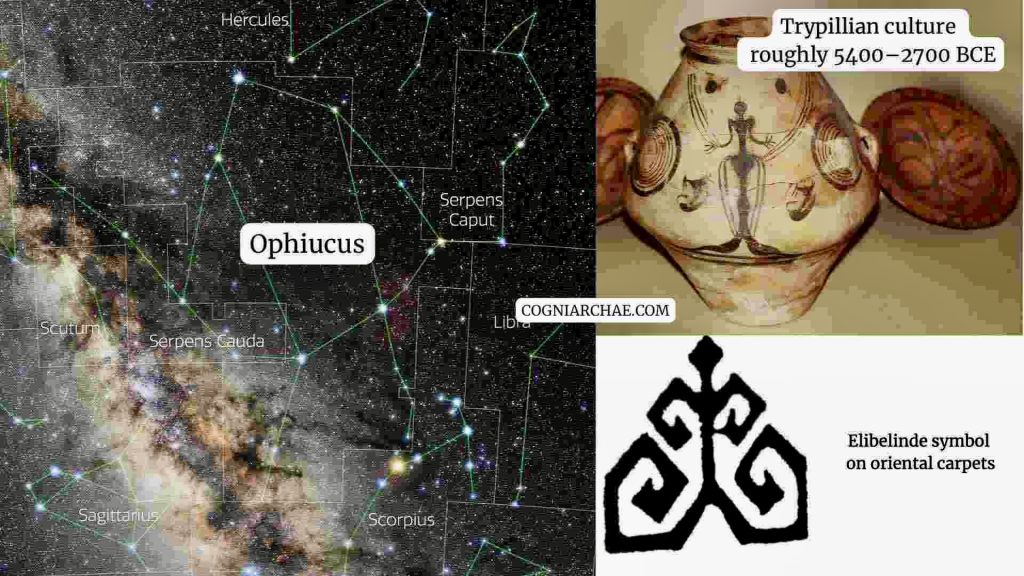
In this case, the counterpart is Ophiuchus, the serpent constellation, whose presence shaped myth from the Ice Age to the Scythian steppe.
The Etymology of Artimpasa
Herodotus recorded the Scythian goddess as Artimpasa.
The first part, Arti-, comes from the Indo-Iranian root arta — a word that meant both truth and cosmic order.
The second part, -pasa or -pasha, resonates strongly with words like pādishāh — the great Persian title of kingship. From this lineage comes the familiar Ottoman pasha.
In this light, Artimpasa is sovereign mistress of Arta, the cosmic order — a female counterpart to rulers like Artaxerxes, “he who reigns through Arta” or “the rightgeous ruler”.
However, in the Eastern Iranian languages once spoken by the Scythians, the word artem meant wheat, barley, or grain. Sogdian texts record it clearly, and in Ossetian the reflex ærtym still means “barley, wheat.”
In this context, Artimpasa appears first as a grain and harvest goddess, just like the later Demeter, whose image was echoed in the sky by the wheat-bearing constellation of Virgo.
This simple agricultural word – artem, rooted in the Indo-Iranian concept of arta (ṛta, cosmic truth and order), reveals an ancient semantic bridge: from grain to order and truth.
So, how did that happen?
The Sky in 8000 BCE: Ophiuchus as Harvest Constellation
Due to precession, the position of the Sun against the stars slowly drifts. Today the Sun passes through Ophiuchus in December. But around 7,500–8,000 BCE, when agriculture began in the Fertile Crescent, the Sun crossed Ophiuchus in late July — right at harvest time.
Thus, the constellation of the Serpent-Holder was not just a healer, but a celestial marker of the first grain harvests. The goddess of wheat, remembered as Artim-pāsa — the Lady of the Grain — was fixed in this constellation long after the heavens had shifted.
From Wheat to Cosmic Order
As centuries passed, precession shifted the harvest sky. Virgo, with her wheat-ear star Spica, replaced Ophiuchus as the agricultural sign. Ophiuchus drifted into winter, and his serpent imagery came to symbolize renewal, rebirth, and hidden power.
The word artem followed the same trajectory. What once meant “wheat” came to mean order, righteousness, truth. The Scythian goddess Artimpasa embodied both layers: fertility of the fields and sovereignty of kings. Greeks identified her with Artemis and Aphrodite, but her imagery — arms outstretched, flanked by animals, sometimes entwined with serpents — looks unmistakably like Ophiuchus.
Sagittarius, Artemis, and the Archer
Next to Ophiuchus in the sky stands Sagittarius, the Archer. The Greeks naturally saw Artemis, the bow-goddess, in this sign. But behind the archer Artemis lies a deeper memory of Artemida = giver of wheat.
Memory of the First Farmers
The Scythian goddess Artimpasa and the Greek Artemis preserve the memory of a time when:
• Ophiuchus was the harvest sign (7th–8th millennium BCE).
• The word artem meant wheat.
• Grain and truth were one and the same.
When people first sowed barley in Jericho and Çayönü, they also planted the seeds of a myth: that a divine figure, holding the serpents of life and death, gave order to the world through the gift of bread.
From Skylla and Tyche to Melusina
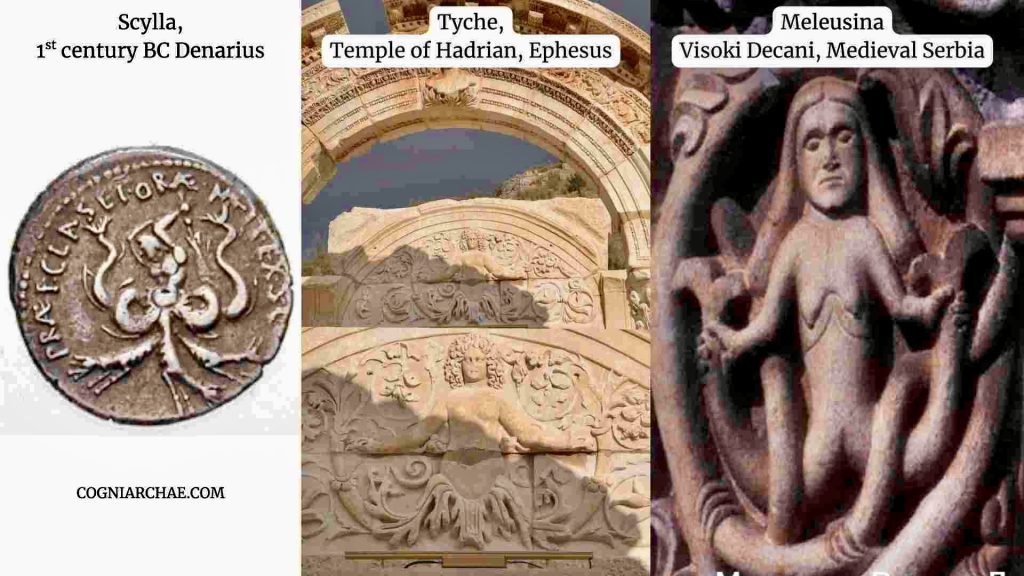
For the classical Greeks, Artimpasa was remembered as Skylla, the serpent-bodied goddess whose name may not only echo Greek skylax (“whelp, young creature”) but also the Scythians’ own name for themselves, the Skolotoi.
Through Greek retelling, the Scythian mistress of sovereignty and harvest became the monstrous guardian of caves and straits, half woman and half serpent, flanked by ravenous beasts.
At the same time, her role as the giver of kingship and fortune made her overlap with Tyche, the goddess of luck and sovereignty. In Hellenistic art she is enthroned, wearing a mural crown (symbol of the city’s walls) — a sovereignty icon very close to Artimpasa as giver of kingship.
In medieval Europe she returned as Melusina, the hidden serpent-lady of romance, binding her fate to mortal men.
These are just a few of her countless names. Even the snake-bearing forms of Isis in Egypt and Hekate in the Greek world may be related to her, distant reflections of the same archaic archetype whose celestial home was always Ophiuchus, the serpent-holder in the sky.
Conclusion
As we have seen, the image of Artimpasa as Ophiuchus predates the Scythians by tens of millennia, lingering in cave walls and deep memory.
Yet it rose to new prominence with the birth of agriculture, when the Sun in Ophiuchus once marked the season of the harvest. In that epoch it likely inspired myths of half-human, half-serpent beings — liminal teachers who brought the knowledge of sowing and reaping to humankind.
On the steppe this memory surfaces in the Trypillian culture, where serpent-bodied female figures are bound to grain and fertility.
The Trypillian culture, dated from 5400–2700 BCE, stands as a vital predecessor to the Scythians and marks the arrival of the first agricultural societies in the lands of Ukraine and Moldova — a region that would, millennia later, become famed as the breadbasket of Europe for its boundless fields of wheat.
It lives on in the patterns of the Oriental carpet, where central lozenges and coiling forms encode the image of the snake-legged goddess.
From there the motif radiates outward: into the myths of Mesopotamia and Greece, through Indo-European migrations, and still today in Southeast Asia, where in Laos the half-woman, half-serpent form — the naga princess — remains one of the most enduring sacred symbols.
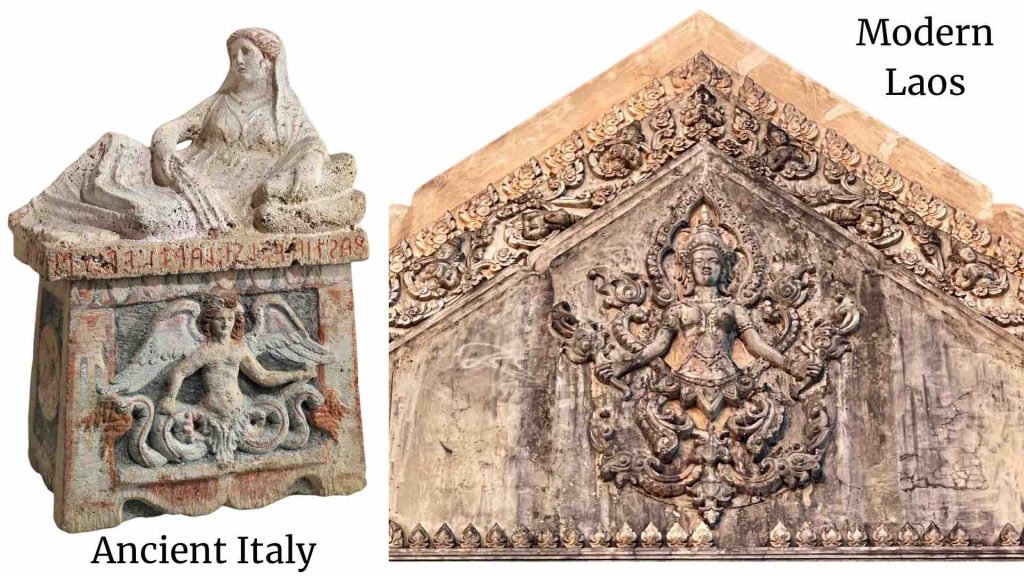
Artimpasa is not simply another fertility goddess equated with Aphrodite or Artemis. She is a living fossil of Neolithic sky-mythology, preserving the moment when language, agriculture, and constellations first fused.
Ophiuchus, once the harvest goddess, shifted into the domain of renewal and sovereignty. Virgo inherited the wheat. Artemis inherited the bow. But the name artem carries both memories — wheat and truth, sustenance and order — all the way from the dawn of agriculture.
In Ukraine and Russia — once the homeland of the Scythians — one of the most common male names is still Artem, or Artyom, carrying that ancient legacy into the present.


