

The origins of Belgrade, known in antiquity as Singidunum (or Singidun), have long intrigued historians and archaeologists alike.
The earliest recorded mention of Singidunum dates back to the 3rd century BC, but the area was inhabited well before that, with traces of human presence from the Paleolithic era, through the Neolithic Vinca culture, and later by the Thracians and Scythians in the 6th century BC.
Unfortunately, the exact names of these ancient settlements have been lost to time. Mainstream history credits the Celts, who arrived in the Balkans a few centuries later, with the founding of Singidunum.
This was the official version Belgrade’s history, often focusing briefly on the prehistoric background before delving into the Roman era when Singidunum became a prominent settlement.
However, the narrative around the founding of Singidunum might be more complex than it appears, particularly when we examine the etymology of its name.
The Etymology of Singidunum
The name “Singidunum” has been the subject of much scholarly debate. Official accounts attribute the foundation of the settlement to the Celts, largely because “dunum” is a Celtic word meaning “hill.” However, this reasoning can be questioned, as “dunum” also means “hill” in Thracian, a language spoken by the inhabitants of the region before the Celts arrived.
So what about the first part – “Singi”? Will Celtic language be of any help? Well, actually no. I mean no theory is official yet. A few scholarly options that we have for the word “singi” are:
1. “round” (therefore round-hill)
2. a name of a Thracian tribe (therefore Thracian words, not Celtic) and even
3. sin-gui, from Gaelic “old prayer” (don’t really know what to say about this one…)
Singidunum – the Lion Hill
The word “Singh” means “lion” in Sanskrit, the ancient language that influenced many Indo-European languages. This raises the possibility that Singidunum might mean “Lion Hill,” a name that resonates with other ancient sites like Singapore (Singha-pura), which also means “Lion City.”
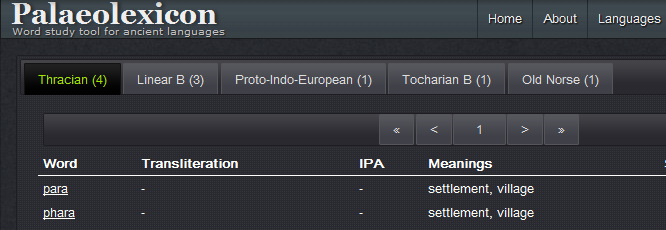
But wait, “pura” also means “settlement, village” in Thracian. And according to Paleolexicon, we see it also in the Linear B script!
Also, Herodotus mentions a Thracian city of Singus in Sithonia, although he does not explain what this word means. And Singidava was an important city of Dacia, modern-day Romania.
But even though Herodotus does not give us the etymology of a name Singus, only a couple of sentences later he states that in this area lions existed until the time of Xerxes:
“In these parts, there are many lions and wild oxen… The boundary of the lions’ country is the river Nestus…” – Hdt. 7,126
So, could it be that “Singidunum” meant “lion-hill”? Are there any other toponyms like that closer than Singapore? Yes, there are. And they seem to follow the migration routes of ancient Aryans. For example, there is one called “lion’s head”, a Thracian sanctuary above the Ropotamo river on the coasts of the Black sea. There is an ancient place called “Arslan tepe” in Turkey (literally “lion-hill”). Another example is in Armenia… and then back to Asia, to the famous rock of Sigiriya in Sri Lanka. These are just a few examples…

Singh – the Vedic Lion-Warriors
So “lion hills” really exist, but if so, how did such an old, Sanskrit word, ended up in Balkans? There can be a very interesting reason for this. Singh is also a title of a warrior caste in India. Even today, it is extremely popular on the Indian subcontinent.
The idea that ancient Aryans could have had a presence in the Balkans is not far-fetched, especially considering the historical connections between the Balkans and India.
Alexander the Great, who reached as far as India, often associated himself with the lion, perhaps in homage to the earlier hero Heracles, who also traveled through Asia. Moreover, Dionysus, a figure from Greek mythology, is said to have been the first to conquer India, further linking the Balkans with this ancient Indo-European legacy.
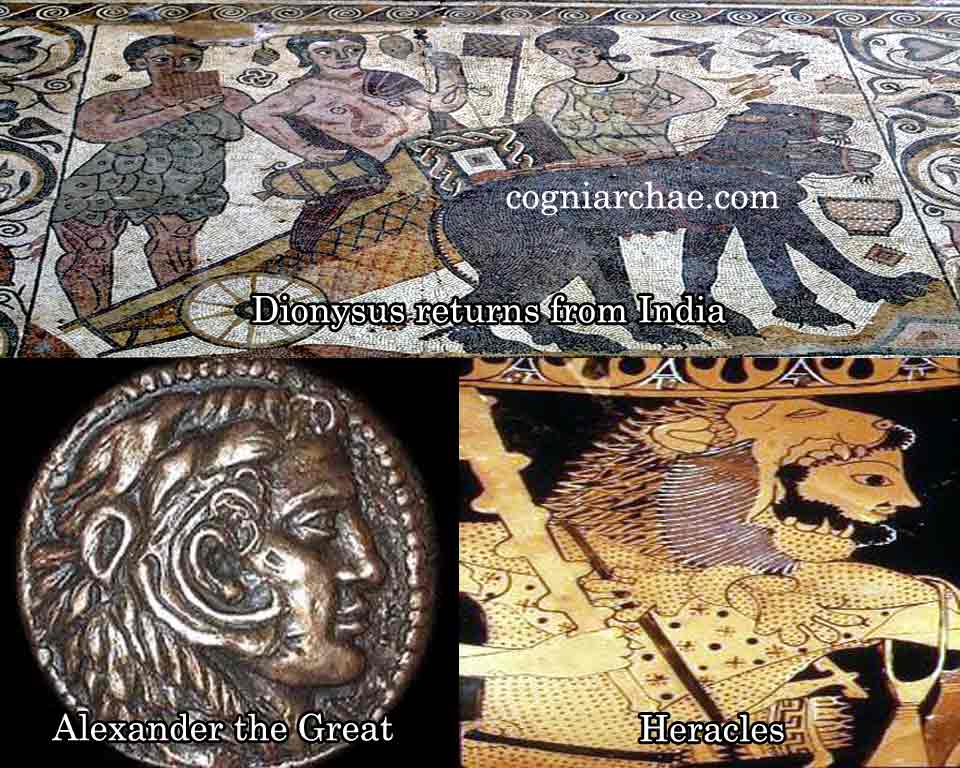
Could this theory explain why Balkans have the highest density of gypsies in the world? They undoubtedly come from North India, where Aryans once thrived? Are they the remainders of an ancient caste system, that was destroyed by the Roman war machine?
Singidunum’s True Location
As we circle back to Belgrade, the exact location of this “Lion Hill” remains a mystery. The Kalemegdan fortress, the most prominent historical site in modern Belgrade, might have once featured a lion-shaped stone. However, the landscape has changed dramatically over the millennia, making it difficult to pinpoint.
However, there is one other very important hill, that could be lion-shaped with just a little imagination. The hill of Avala.
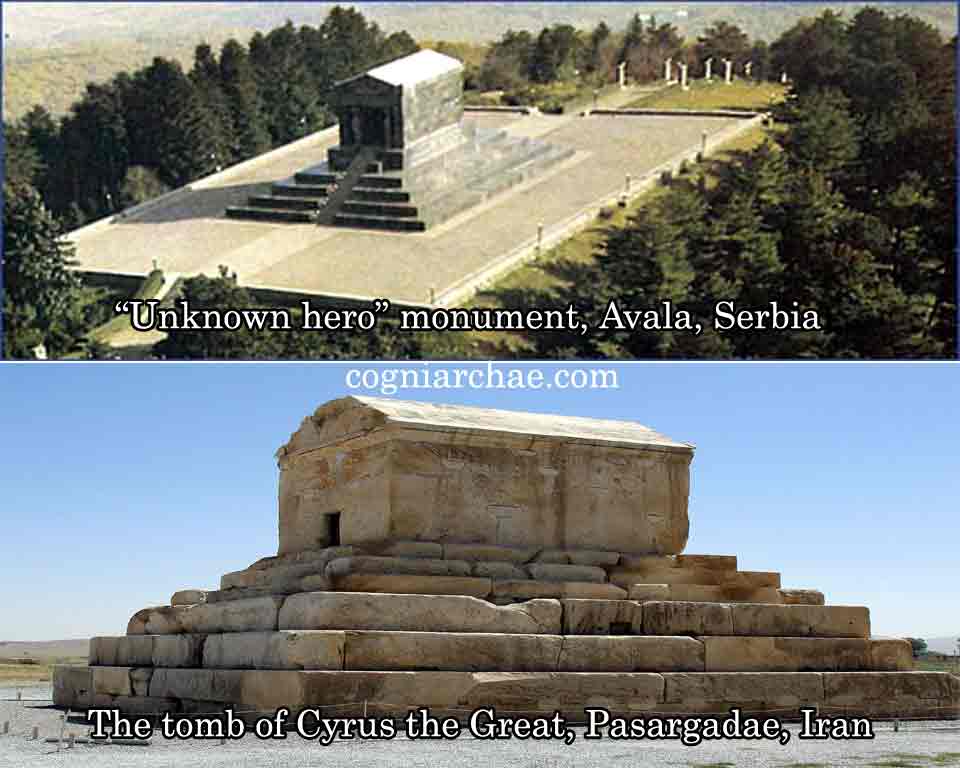
Avala Hill, situated 16.5 km south of Belgrade, still looms majestically like a Sphinx, guarding the entrance to the city along the M1 highway, which follows the exact path of an ancient Roman road. This hill has been a site of human habitation since ancient times, with remnants of Roman mines still visible on its slopes. During the Middle Ages, the Slavic fortress of Zrnov crowned its summit. However, in 1934, the entire area was tragically demolished with dynamite to make way for a Masonic monument dedicated to an “unknown hero.”
So what lies under the monument of Avala? Maybe we will never know. But what we do know is that on the map by Anselmo Maria Banduri (1675-1743), Belgrade and Singidunum are two different cities, Singidunum being very close to the hill of Avala.

An unknown hero, or Cyrus the Great?
The “unknown hero” monument is also quite interesting. Its purpose was to “commemorate a fallen Serbian hero”, but the inspiration behind it was a tomb of a Persian (Aryan) emperor Cyrus the Great, whose empire stretched from Balkans to the Indus river.
Finally, there were once at least five other places named “lion city” or “Singapore” across Asia. These include Singapura of the Champa kingdom in Vietnam, Sing Buri in Thailand, Sangkapura on Bawean Island in Indonesia, Singapura in West Java, Indonesia, and Singapura in India.
However, apart from India and the Balkans, none of these regions were home to lions in their natural habitat.


In my opinion Singi-dunum means fortress near river, fortress near water. The element singi corresponds to Sankr. sikati, secate- to besprinkle, to moisten, Avest. hincaite- to water, to mosten, Ger. seihen, Ned. zeiken – to water, to urinate, O.Blg./OCh.Sl. sikati-to water, to urinate, Blg. singur-salamander.
Singi corresponds to Thrac. singi, sanga – to water, to moisten. As you have already mentioned, Singos is Thracian city, it was situated on the coast of the sea. Singi-dava in Dacia, near Danube is another related name, Saci- dava can be added too. Element sang we find in the name of river Sangarios, Phrygia. Not to forget Sigeion in Troad.
If the name Singi-dunum was Gaulish, it would sound more like Sago-dunum. Sago would be the Gaulush word related to Thrac. sanga, singi- to water, to moisten. The element Sago we can find in the Gaulish ethnonym Tecto-sagi – Οὐόλκαι Τεκτόσαγες – Volcae of the running waters, Volcae who live near rivers.
There is another Gaulish word, which shows resemblance with the element Singi, that is singilion – kind of cloth, dress. However it is not very convinsing. The name of river Sequana is related to Singi-dunum, but I have difficulty to find a Celtic word with root SEC, SAG and meaning water, moist, sprinkling. The closest one is the Welsh sgeintiwch- to sprikle.
सिन्धु (sindhu) – river
Hi, the word DUNUM is still beiing used by some farmers in remote area. Is is an old Serbian word for measuring an amount of land corresponding to about 1000 square meters.
http://www.zdravasrbija.com/lat/Zdrava%20Srbija/1254-Stare-mere-za-povrsinu.php