

This article is part of an ongoing series exploring the metal detecting discoveries in the Balkans. Unfortunately, many of these finds are swept into the shadows of the black market, disappearing without a trace and depriving us of their historical value.
Through this blog, I aim to document and preserve the evidence of these artifacts, ensuring they are not forgotten and remain a part of our shared cultural heritage. Sadly, in most cases, local museums show little to no interest in acquiring these finds.
A couple of days ago, while browsing one of these metal detecting groups, I came across an intriguing find: a broken ring, bearing an inscription in what appears to be a lesser-known script. I reached out to the individual who had posted the images and I learned that the ring was discovered in an agricultural field, near Nis, south Serbia. There were a few other small object in the viscinity.
The person who found the ring had no knowledge of its age or historical period, which is why they sought advice from the metal detecting group.
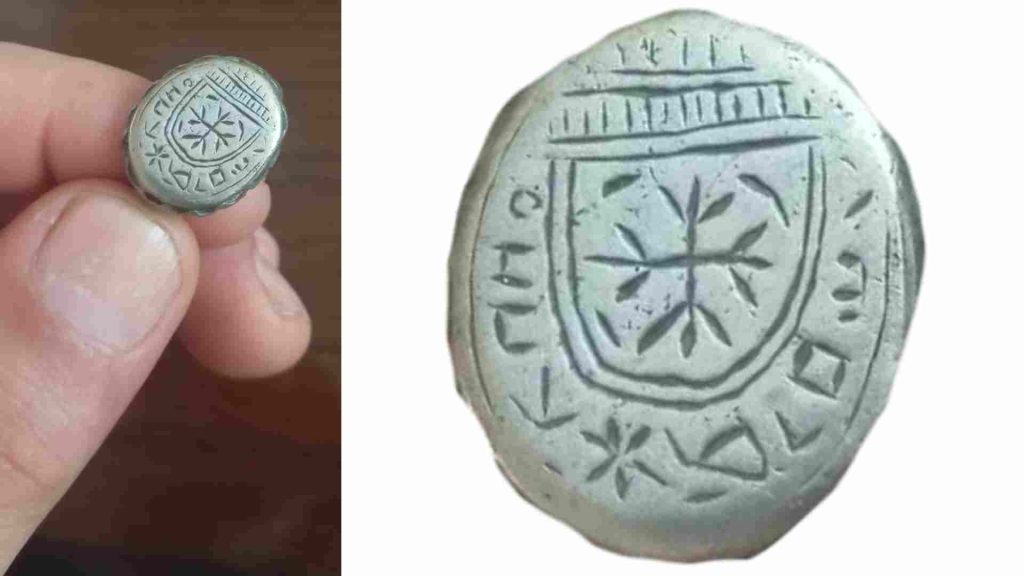
The central image
Before delving into the inscription, let’s first examine the ring’s central feature: a crest or coat of arms of a sort. It’s main feature is an unusual star, which resembles a snowflake. Its distinct shape sets it apart from more typical heraldic symbols.
However, this design was very popular on medieval Jewish rings, some of which were discovered in Europe.
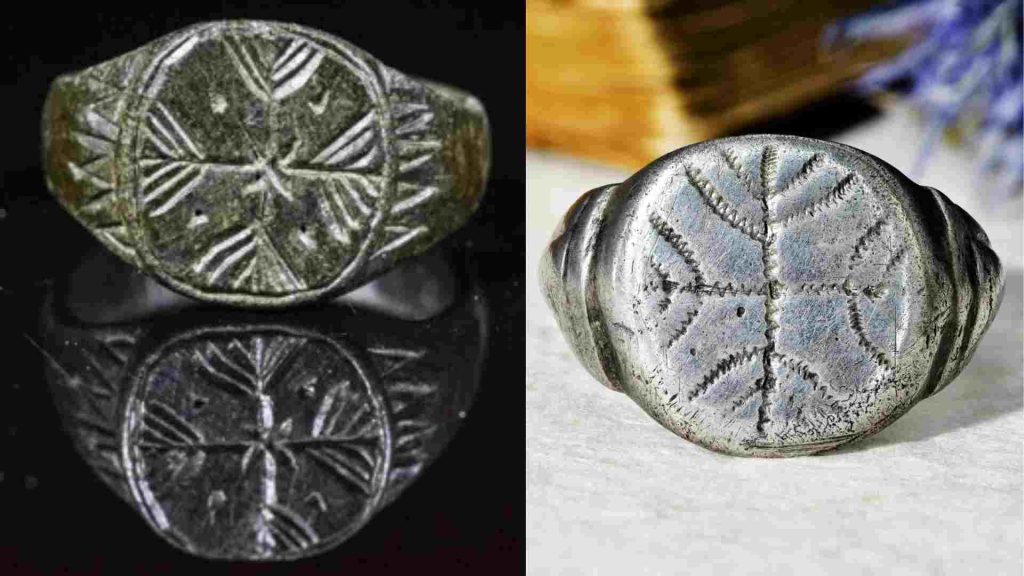
However, the letters of the inscription are definetely not Hebrew letters. They look more like Turkic and Avar scripts from the steppe. And that can mean only one thing – Khazars.
Who were the Khazars?
The Khazars were a semi-nomadic Turkic people who established a powerful empire in the steppes of Eastern Europe between the 7th and 10th centuries. Their territory extended from the Caucasus to the Volga River and included parts of modern-day Russia, Ukraine, and Kazakhstan.
The Khazar Khaganate played a pivotal role in regional trade, acting as intermediaries between the Byzantine Empire, the Islamic Caliphates, and other European and Asian powers. Notably, in the 8th or 9th century, some members of the Khazar elite converted to Judaism, a unique aspect of their history. The Khazars eventually declined in the 10th century, after military defeats by Kievan Rus and other regional powers.
Khazars in Serbia
The Čelarevo site, located in modern-day Serbia, is one of the key archaeological sites that suggests a Khazar presence in the region during the 8th and 9th centuries. This necropolis contains over 100 graves, many of which have been linked to the Khazars due to the style of burial and the grave goods, including items of steppe origin like horse equipment, weapons, and jewelry. The finds at Čelarevo suggest a multi-ethnic population, with evidence of Khazar, Bulgar, and other influences in the region during this period.
However, there are other toponyms that are not traditionally linked to the Khazars but may have connections. One such example is the town and mountain of Kozara. In the Kievan Letter, the Khazars were referred to as “Kozara”. This perhaps points to a wider presence of the Khazars, which must have been present in Serbia in this period, together with Avars and other related peoples.

The Khazar Language
The Khazar language was a Turkic language, likely part of the Oghuric branch, which includes other languages like Bulgar and Chuvash. Unfortunately, very few Khazar inscriptions or written records have survived, making the language difficult to reconstruct in detail.
Some of the most notable evidence comes from the Kievan Letter, a document written in Hebrew script, which includes Khazar names and mentions a Khazar ruler. At the end of it, there is only one word, believed to be Khazar. It is read as okhqurüm/hokurüm/hakurüm, and it simply mean “I read it)”.
Interestingly, these might be the very same letters that we see on our ring.
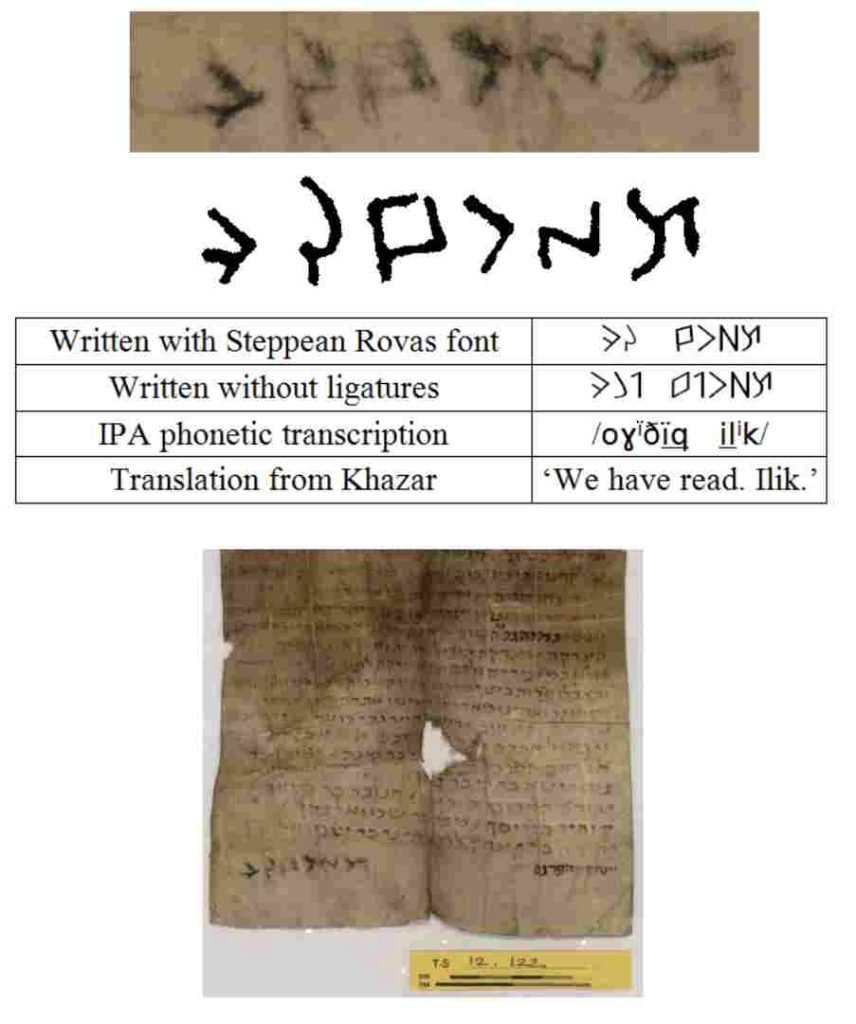
Steppean Rovas
Steppean rovas refer to an ancient writing system or script used by various steppe nomadic peoples, particularly Turkic groups, including the Khazars, Bulgars, and early Hungarians. The word “rovás” comes from Hungarian and means “carving” or “script,” as these characters were often carved into wood, bone, or stone.
The most well-known example of such a script is the Old Turkic script, also called the Orkhon or Göktürk script, which was used by Turkic peoples of the Central Asian steppes. These steppean rovas were typically runic in appearance, featuring angular shapes that were easy to carve.
In the Balkans, two closely related scripts were prominent: the Hungarian Rovás, primarily used in Pannonia, and the Siculorum Rovás, found in and around Transylvania, Romania. Both scripts share similarities, as they evolved from the broader tradition of Turkic and steppean writing systems, though they were adapted to the local languages and cultures of the regions in which they were used.
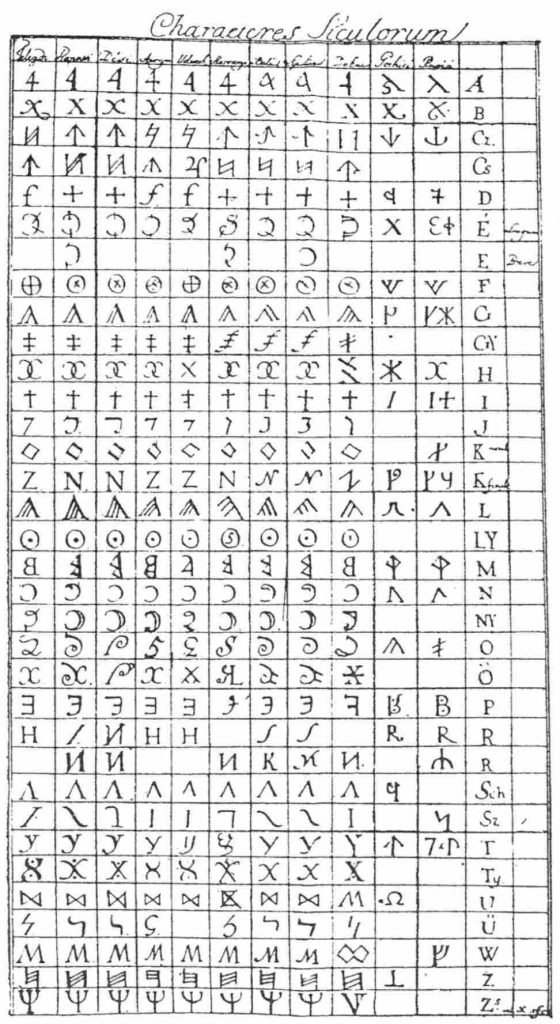
Reading the Inscription
Now, aside from the obvious connection to the menorah and its similarities to medieval Jewish rings, what I find particularly intriguing is that all of the letters in the inscription can be identified within the Siculorum Rovás syllabary.
However, the reading process is not entirely straightforward, as some letters offer multiple possible interpretations. This makes it challenging to determine the correct reading, especially since I can’t rely on intuition due to my lack of fluency in the language.
In any case, what I came up with is the reading:
Yo r yu cz h a l k e sz
I believe that these are in fact two words: Yoryucz halkesz.
The word “halkesz” is probably more straightforward, as “halk”, means “people, tribe, nation” in Turkic languages. See here.
The first part of the inscription is more difficult to decode, but logically, it likely represents the name of the people in question. The closest match to “Yoryucz” appears to be the Yörüks, a nomadic Turkic tribe. Their presence is well-documented in southern Serbia, Macedonia, and extending all the way to Turkey. Given their historical mobility and influence across these regions, it’s possible the inscription could reference them or a related group.
The only problem with this theory is that we have no historical evidence that the Yörüks were once in the Khazar ranks, but given the size of the Khazar Khaganate, and the nomadic nature of the Yörüks, this theory is not at all far-fetched.
And perhaps, the real value of this ring is that it provides a historical evidence for it?


What makes you think this is Khazar? It can be yensei too. The center piece can also be Nogai.
It could be, but only Khazar finds are well documented in Serbia, so that would be my first guess.