
The image shows a Neo-Assyrian relief from the first millennium BCE. At first glance, it seems like a familiar royal motif: a king or high priest standing before the “Tree of Life.” But looking closer, the details are striking.
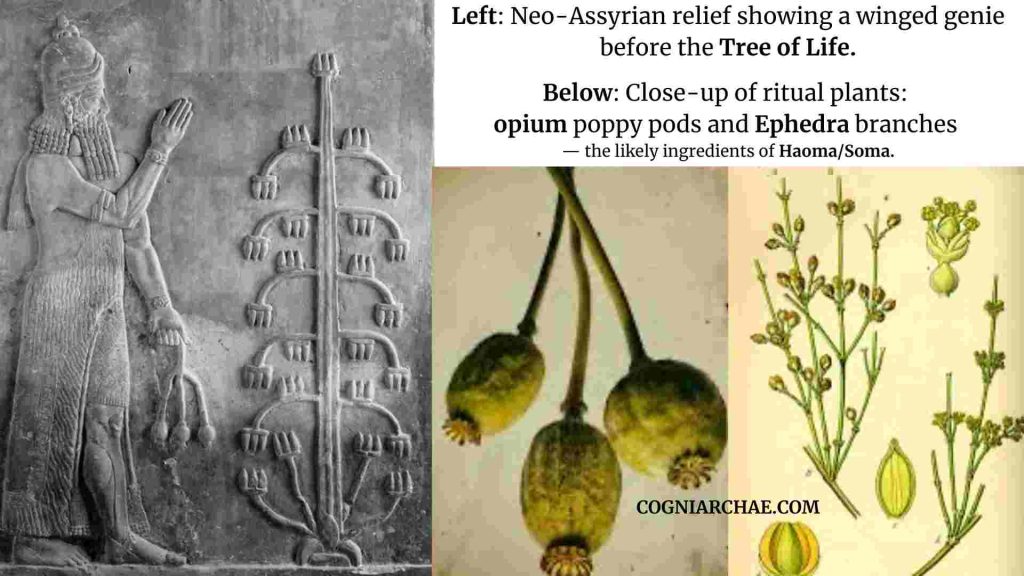
In his hand, the figure holds a bundle of poppy pods — instantly recognizable by their rounded heads and crown-like tops.
Before him rises a stylized plant with a tall stalk and symmetrical tiers of offshoots. This “tree” doesn’t resemble a cedar or palm, as it is often described, but looks much more like Ephedra, the ancient jointed shrub used for ritual drinks in Central Asia and Iran.
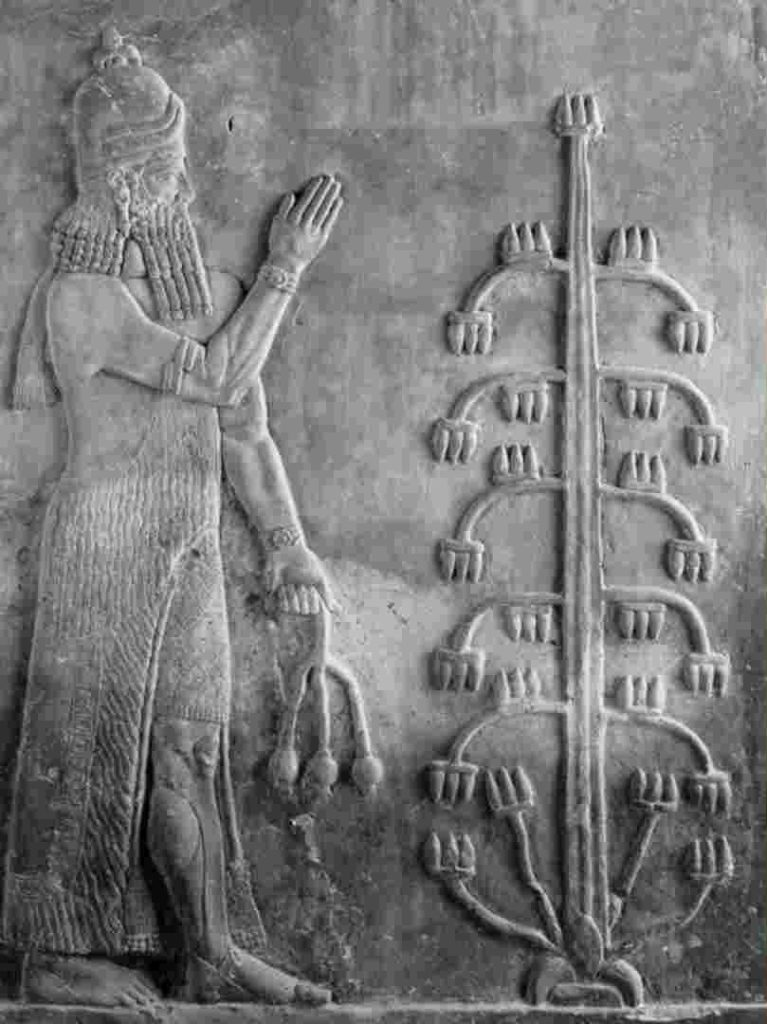
The Tree of Life as Ephedra
The relief suggests that the so-called “Tree of Life” may in fact be a ritual plant. Ephedra grows with regular joints and whorled branches, almost exactly as depicted in the carving.
Combined with the poppies in the king’s hand, it points to a ritual recipe: a stimulant plant paired with an opiate, producing a sacred mixture that balanced wakefulness and dream.
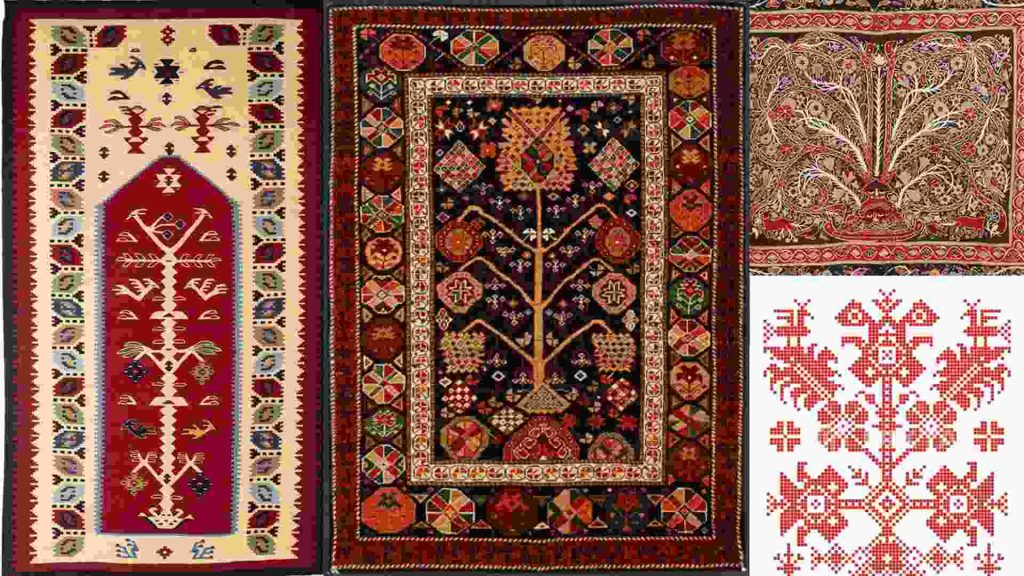
This same stylized tree appears again and again, not just in Mesopotamian art but also woven into oriental carpets. Many rug designs feature a central axis tree with repeating levels, blossoms, and branching symmetry.
The Tree of Life is an ancient symbol with layered meanings, often cosmological, yet it is also highly plausible that part of this tradition reflects the image of the sacred ritual plant.
If these motifs preserve the image of Ephedra as the Tree of Life, then they may also preserve a memory of the ritual drink made from it.
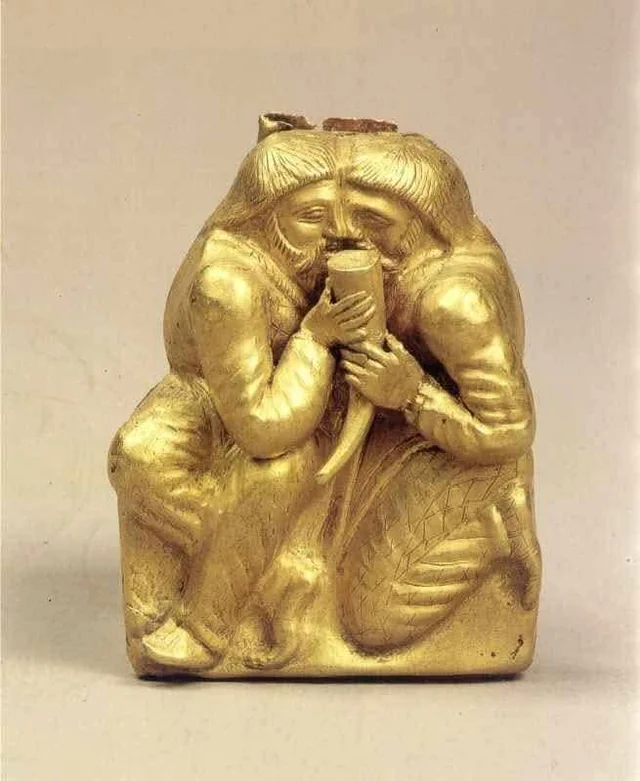
Haoma: The Pressed Drink
In the Iranian world, this drink was called Haoma (Avestan) or Soma (Sanskrit).
The name itself comes from the Indo-Iranian root sauma-, meaning “the pressed [juice].” The plant was pounded with a pestle, its juice strained, and then mixed with water, milk, or pomegranate.
Archaeological finds from Central Asia (the Bactria–Margiana complex) show ritual vessels with traces of Ephedra, poppy, and cannabis.
In Zoroastrian tradition, Ephedra remained the central Haoma plant, valued for its stimulant properties and association with divine vitality.
But here is a thought. If the Tree of Life in Mesopotamian reliefs is Ephedra, and if oriental carpets continued to depict the same plant, then perhaps the ritual of Haoma or Soma was also remembered across the entire oriental world.
A Slavic Connection – Przęśl – The Pressed Drink
In Polish, Ephedra is called Przęśl, a word derived from pręsiti — “to press”, “to squeeze.”
This is not a borrowed name of the plant, but a native Slavic formation.
That makes Polish the only other Indo-European language where Ephedra carries a name connected directly to pressing, just like Haoma/Soma!
Among Slavs, Ephedra is well-recorded in folk medicine as a treatment for coughs, fevers, and exhaustion. The name Przęśl could reflect this medicinal role.
Yet the parallel with the Iranian Haoma raises another possibility: perhaps the Slavs preserved a distant echo of the same Indo-European tradition of pressing Ephedra for ritual drinks? Did the ancient Slavs drink Haoma?
Komina and Koma — A Slavic Word for “Pressed Juice”
A major clue lies in the older Slavic meanings of koma / komina, which refered to to pressed, squeezed, or strained substances. This places the word in the same semantic realm as Haoma / Soma, as a possible cognate.
This linguistic overlap alone is extraordinary, but the ritual context makes it even more compelling.
Komoedica Spring Festival
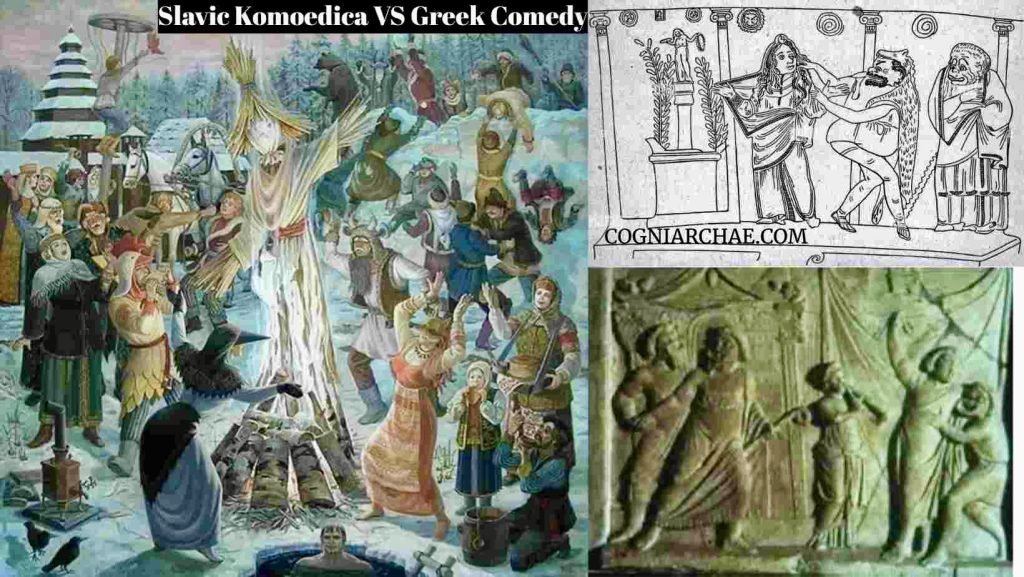
Komoedica is an old East Slavic spring festival marking the end of winter and the return of abundance, originally celebrated before Christianization. It involved communal feasting, the first dairy products of the year, ritual pancakes, and offerings of food to household and nature spirits. Fires were lit, winter effigies were destroyed, and people performed rites meant to awaken the earth, protect livestock, and ensure a fertile agricultural season.
The name literally means “the eating of koma,” which some scholars interpret as “lumps” (early thick pancakes).
But as we’ve seen, the word koma can also refer to a pressed or squeezed substance – quite similar to haoma.
What Did Slavs Drink During Komoedica?
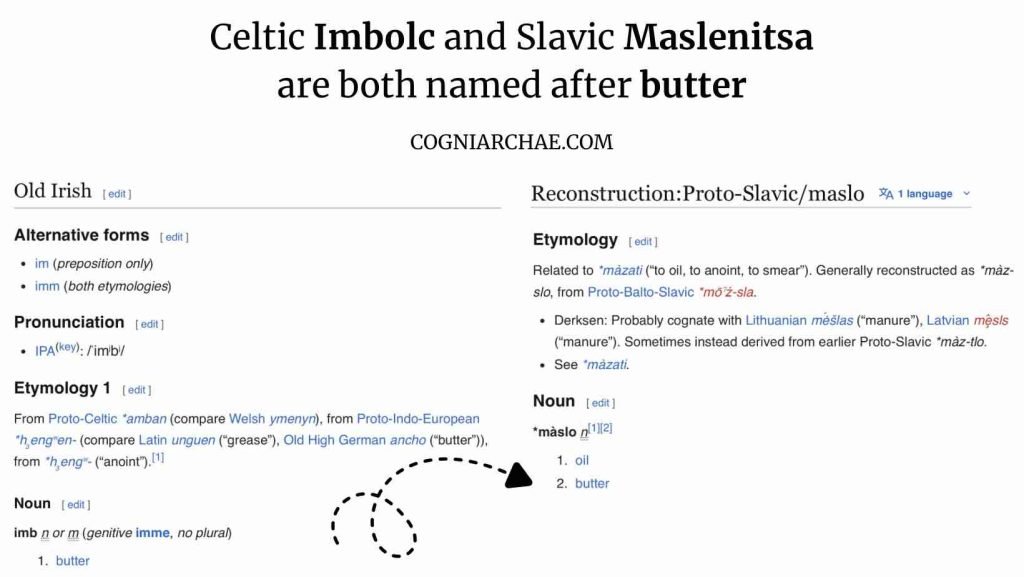
To understand Komoedica, we must look at its surviving alternate name: Maslenitsa, “Butter Week.”
This week was famous not for pancakes, but for something far older and far more symbolic:
It marked the first dairy products of the year after the winter scarcity.
In traditional Slavic life:
• winter meant no fresh milk
• animals were pregnant and yields were low
• dairy returned only in late winter–early spring, around February–March
Thus Maslenitsa celebrated:
• the return of milk
• the return of fat and nourishment
• the ritual end of winter hunger
Ephedra Blooms in Early Spring — Exactly When Komoedica Was Celebrated
The ritual plant behind Haoma, Ephedra, is one of the first plants to awaken after winter.
Across Central Asia, Iran, and Eastern Europe, Ephedra species:
• bloom from late February to April
• produce fresh, alkaloid-rich shoots
• appear precisely when dairy returns
Indo-European spring rites — including Haoma pressing, Vasanta festivals, and Nowruz — occur at the exact moment when Ephedra becomes active, and milk begins flowing again.
Therefore, Slavic Komoedica / Maslenitsa mirrors this Indo-Iranian tradition, where the sacred Haoma drink was:
• pressed from a spring plant (Ephedra)
• mixed with fresh milk
• consumed at the seasonal moment of rebirth
This suggests that Komoedica may preserve a faint but genuine echo of the Proto-Indo-European spring ritual that later evolved into Vedic Soma pressing, Iranian Haoma ceremonies and Celtic Imbolc dairy rites, amongst many others.
The Komedes – Haoma Eaters
There is one more thread worth following – an obscure people in Central Asia called the Komedes.
The Komedes, known from Ptolemy’s Geographia and later Greco-Iranian and Sanskrit sources, occupied the mountain zone between the upper Jaxartes and the Pamirs—a region that for more than a millennium formed the cultural heartland of the Soma/Haoma tradition.
However, Ptolemy also marked Komidava (dava = settlement) in Dacia, modern day Romania, on the eastern fringe of the Carpathians.
This dual placement is striking, because both regions lie on the cultural frontier of the ancient Soma/Haoma world and overlap with what many scholars consider the early Slavic homeland.
Their name appears in multiple classical forms—Komedes, Komoi, Kamoi, Kumuda, Homodotes—and they all preserve the same Indo-European kom-/kam-/hom- base.
If Komoedica means “the eating of koma,” then the ethnonym Komedes may come from the same Indo-European ritual vocabulary: “the koma / haoma eaters”
The closest parallel is the ancient Persian ethnonym Haumavargā, applied to the Saka who took part in the Haoma ceremony.
The term derives from hauma combined with Iranian *hvar-, “to consume, to eat or drink,” here expanded by the characteristic -g- to form an agent noun. Thus Haumavargā means simply “those who eat / drink Haoma.” In other words, it sounds like a Persian translation of Komo-edi.
If this interpretation is correct, then the Komoedica festival does more than preserve a Slavic spring rite. It illuminates a forgotten Indo-European worldview in which the pressing of the first plant and the return of the first milk marked the beginning of the ritual year. Ephedra blooms at precisely this liminal moment — late winter to early spring — when dairy production also resumes after the dark scarcity of winter.
The Slavic festival and the Iranian ceremony are separated by distance and millennia, yet both revolve around the same seasonal triad: the awakening of Ephedra, the return of dairy, and the making of a pressed sacred substance.
The Komoedica, therefore, may be one of the last surviving European echoes of the Soma–Haoma complex. And the name of the ancient Komedes, far from being a curiosity, may be a linguistic fossil from the same ritual world.
Greek Comedy and the Indo-European Ritual of Intoxication
This brings an unexpected parallel into focus. In ancient Greece, the word komos referred to a ritual procession marked by intoxication, sung invocations, and ecstatic behaviour—an event far older than theatre. From komos came komoidia, “comedy,” literally “the song of the komos.”
The resemblance between komoidia and Komoedica is striking, especially if we consider the Latin form comoedia.
More importantly, the style of Greek comedy—raucous, chaotic, and rooted in drunken spring revelry—fits perfectly within the broader Indo-European pattern of seasonal rites involving pressed substances, communal intoxication, and ritual celebration.
Conclusion
Seen together, the Slavic Komoedica, the Iranian Haoma rite, the Greek komos, and the scattered ethnonyms built on kom- form a single Indo-European ritual pattern: a spring ceremony centred on pressing plants, returning milk, and controlled intoxication.
Its coherence across such distant regions suggests great antiquity. The symbolism points back to the Neolithic, when the spring equinox rose in Taurus, the celestial bull or cow, while Virgo—the maiden, the grain-giver, the Brigid-like figure—stood opposite on the western horizon. This cosmic axis mirrors the seasonal logic of the rites themselves: the awakening of the year, the first milk, the first green shoots, and the making of a sacred substance.
Even the Vedic “churning of the milk”, the act that produces butter, belongs to this same tradition and survives in the spring dairy festivals of Europe, from Maslenitsa to Imbolc, where the return of milk marks the rebirth of the world.
And beneath it all lies the often-overlooked visionary layer: the hallucinogenic mixtures of the Soma–Haoma world, the ecstasy of the komos, and the lingering memory of rites like those at Eleusis and in Dionysian myth.
