

“The Goose Girl” is a classic German fairy tale collected by the Brothers Grimm and published in their 1815 collection Grimm’s Fairy Tales (number KHM 89). It belongs to the Aarne–Thompson–Uther tale type 533, which centers on the motif of the false bride.
What if a quiet fairy tale about geese and golden hair wasn’t really about geese or girls at all — but about Venus, the Milky Way, and the solstice gate of the heavens?
Core Themes and Plot Summary
The story tells of a princess who is sent by her widowed queen mother to marry a faraway prince. She travels with her speaking horse Falada and a waiting maid. The queen gives her daughter a protective charm, but the journey turns treacherous:
- The maid revolts, refuses to serve, and eventually forces the princess to switch roles and horses under threat of violence.
- The maid rides off as the princess and has the real princess assigned to herd geese with a boy named Conrad.
- Fearing Falada might reveal the truth, the maid orders him beheaded, but the princess arranges for his head to be nailed over a gate so she can still speak to him.
- The princess’s unusual behavior (such as talking to Falada’s head and using wind magic to keep Conrad away while she combs her golden hair) alarms the boy, who tells the king.
- The king spies on her and, learning the truth (through her confession to an iron stove), restores her identity and punishes the maid — often by having her dragged in a spiked barrel until death.
- The true princess marries the prince, and they live happily ever after.
Falada: A Name That Shouldn’t Be There
On the surface, the tale seems like a quintessential German folktale: a princess is betrayed by her maid, forced into silence, and assigned to herd geese until a king uncovers the truth. But one name breaks the illusion:
Falada — the talking horse.
This word has no meaning in German. It is not a derivation of Pferd, Ross, Gaul, or any traditional Germanic word for horse or speech. But in Portuguese, the word falada means “spoken”, from falar, to speak.
In other words, Falada is not a name. It’s a descriptor — “the spoken one.”
That one word is enough to destabilize the idea that The Goose Girl is a purely German folk creation. It suggests the tale was already translated or remembered through foreign tongues before it ever reached the Grimms.
And Dorothea Viehmann, whose family had migrated from France, may have preserved a version of the story filtered through Romance-language speakers, possibly even Iberian or Romani oral traditions.
Conrad or Canard?
Another clue lies in the name of the goose-herding boy: Conrad. While this appears to be a typically German name, it may actually be a misremembering or translation of the French word canard — meaning duck.
A princess tending geese, accompanied by a boy whose name echoes duck, fits perfectly with ancient Eurasian bird-soul cosmologies. In Slavic, Baltic, and steppe cultures, geese and ducks are more than animals — they are migratory souls, seasonal spirits, and constellations in motion. It would be entirely fitting for the tale to feature a “duck boy” and a “goose girl” walking the star-path together — a humanized rendering of celestial movement.
Only when the story was retold in German did le canard become “Konrad”, a name that German readers would find believable, though utterly divorced from its mythic root.
The Likely Route of Transmission
The story reached the Brothers Grimm through Dorothea Viehmann, their trusted source for The Goose Girl. But Viehmann was no ordinary peasant storyteller — she came from a French Huguenot family that had fled religious persecution and settled near Kassel, in what was then the Landgraviate of Hesse.
Her background matters. It suggests that the tale she passed on wasn’t originally German at all. The linguistic clues — Falada, a clearly Portuguese word meaning spoken, and canard, the French word for duck — point to a story that likely originated in Portugal or western Iberia, traveled through southern France, and only entered German folklore via the Huguenot oral tradition.
Dorothea Viehmann may well have been the final link in a long chain of transmission, preserving not just a fairy tale, but a fragment of Bronze Age sky-religion — encoded in language, worn smooth by generations of telling, and finally recorded by the Grimms without any sense of the ancient cosmology it once carried.
Sky Maps in Disguise: An Astronomical Reading of The Goose Girl
Across ancient cultures, stories were written not just in words, but in stars. And The Goose Girl appears to be one of them.
Below is a proposed celestial mapping of the story’s main characters and motifs:
| Element in the Story | Astronomical Counterpart | Symbolic Role |
| The Princess | Venus / Virgo | Celestial maiden, light of the sky, betrayed and cast down |
| The Maid | Scorpius | Shadow twin, deception |
| Falada | Equuleus (Head of a Little Horse) | Decapitated wisdom, guardian of memory at the gate |
| The Geese | Milky Way stars | Migrating souls, star-flock |
| Conrad (the boy) | Cygnus / Canard | Duck or swan along the Milky Way, curious youth |
| The King | Jupiter / Orion | Cosmic judge, enforcer of justice |
| Iron Stove | ❗️Fornax (modern) or Eridanus (ancient) | The confessional underworld gate |
| The Lost Charm | Corona Borealis | The lost crown or cosmic token of identity |
| Her Hair | Coma Berenices | Sacrificed femininity, celestial beauty |
| The Gate beneath Falada | Capricorn–Aquarius boundary | The solstitial portal, the threshold of rebirth |
The Sky-Myth Encoded in the Fairy Tale
The princess — Venus — begins her celestial journey across the heavens, perhaps preparing for sacred union. But as she descends toward the autumn horizon, she is betrayed by Scorpius, the shadow rising in her place.
The talking horse Falada, her cosmic companion (Equuleus), is slain and nailed above a celestial gate — the very boundary between Capricorn and Aquarius known in ancient cosmologies as the Gate of the Gods, the entry into the underworld, or rebirth point of the Sun and Venus.
Tending geese in the cold meadow of stars, the fallen Venus walks the Milky Way — now one of the wandering, exiled souls.
Her golden hair (Coma Berenices) still shines, and the boy Conrad (or Canard, the duck — echoing Cygnus) follows her path with childlike awe. But the truth cannot be spoken — not to any soul — only to a non-living gatekeeper, which in the Grimm version becomes the iron stove.
This element is telling. In older versions of similar tales, the secret is told to a tree, a rock, or even a river. Perhaps this confessional moment preserves the memory of Eridanus, the celestial river — a mythic underworld stream appearing just below Orion and stretching across the winter sky.
Finally, the king (Orion? Jupiter?) restores her royal garments and uncrowns the usurper. Venus ascends once again.
The Bronze Age Origins: Venus, Ducks, and the Solstice Gate
The talking horse Falada, her cosmic companion (Equuleus), is slain and nailed above a celestial gate — the very boundary between Capricorn and Aquarius known in ancient cosmologies as the Gate of the Gods, the entry into the underworld, or rebirth point of the Sun and Venus.
And there is hard archaeological evidence to support this deeper layer:
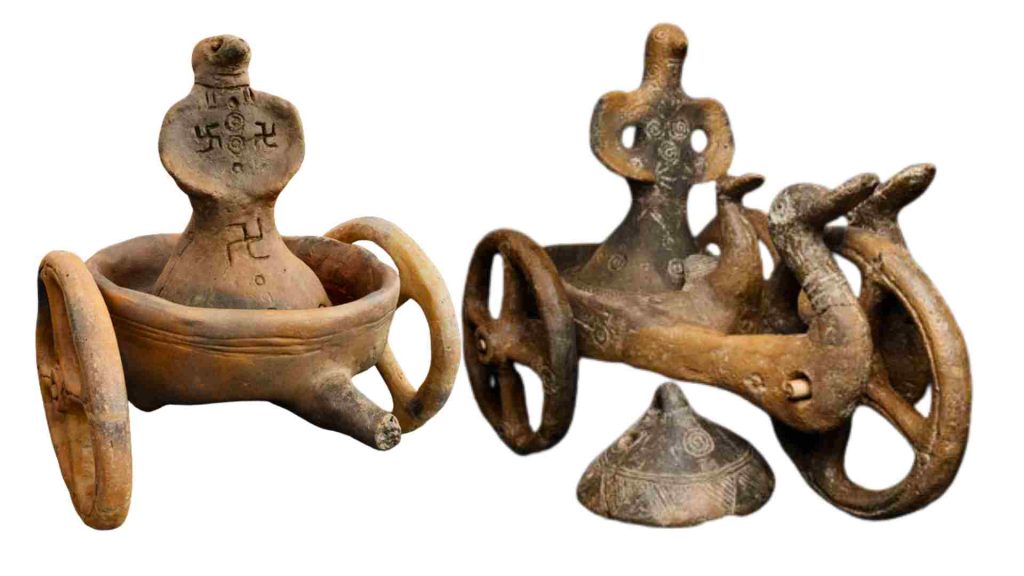
The Dupljaja Chariot (Serbia, c. 1500–1300 BCE)
• A female figure rides in a bird-headed chariot — likely a Venusian soul-vehicle. Birds here represent ducks or geese, aligning with the princess’s star-tending role in the tale.
Cycladic Art (Aegean Bronze Age)
• Repeated imagery of hair-combing maidens, bird-headed figures, and female psychopomps. Strong associations between Venus, death, and celestial rebirth.
Duck and Swan Symbolism
• From Slavic veela to Hindu hamsa, bird-women guide the dead, fly the Milky Way, and descend into underworld rivers. The geese in The Goose Girl may represent souls, or even star clustersmigrating along the zodiacal path.
Final Reflection
The Goose Girl is not a tale of passive innocence — it’s the descended goddess, the solar/Venusian identity stripped, walking the dark path beneath the stars, whispering the truth into the mouth of the earth, and rising again with crown and memory restored.
In this light, it joins a universal pattern of mythic descent and return:
• Inanna and Ereshkigal — two faces of the same goddess, torn and reunited.
• Persephone — stolen from the world, returned by truth and seasonal justice.
• Psyche — betrayed, humbled, purified, and reborn divine.
This suggests that the tale’s symbolic system is not medieval or literary in origin, but a deep inheritance from Indo-European and pre-Indo-European cosmologies, reshaped over millennia but still carrying the mythic structure of the stars.
One of the earliest known goddesses associated with geese, dreams, and divine justice was Nanshe, a Sumerian deity from the third millennium BCE, who guided the souls of the displaced and listened to the unheard — a celestial archetype long before The Goose Girl was ever written down.
Though the Grimm tale presents the marriage as a simple happy ending, in mythological terms it echoes a sacred marriage, where the restored Venus unites with the king and cosmic balance is renewed.

So the next time you read The Goose Girl, look up.
You may just see her walking the sky, passing under the horse’s head, whispering into the dark.


